
A New Wine Legacy For EOS
Winemaker Nathan Carlson has been appointed Director of Wine Making at the Paso Robles EOS winery.
by
Arthur Z. Przebinda
May 5, 2008
Winemaker Nathan Carlson has been appointed Director of Wine Making at the Paso Robles EOS winery.
In a press release sent out Thursday, April 24th, EOS Estate Winery announced the appointment of Nathan Carlson to the position of Director of Winemaking. Carlson is leaving his position as winemaker at Tolosa where he worked closely with Larry Brooks.
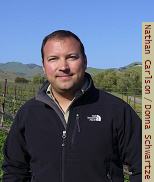
Carlson is a rural Minnesota native. He studied Marine Science before coming to California’s Central Coast. He made wine in Santa Barbara County (Sanford), San Luis Obispo County (Laetitia, Claiborne & Churchill) and moved on to Oregon’s Dundee Hills (Lange Estate). He returned to California in 2005 when he accepted his position at Tolosa. In August of 2007, Tennessee-based Sapphire Wines LLC purchased EOS, as well as approximately 60 acres surrounding the property on Highway 46, east of Highway 101 in Paso Robles. The Arciero family (who still own about 600 acres of vineyards in the Paso Robles area following the sale of the winery) established the vineyards comprising the larger EOS estate in 1983 and released their first wines in 1997. Known primarily for its Cabernet and Petit Syrah as well as the "Tears of Dew" Late Harvest Moscato, the winery also bottled Chardonnay, Chenin Blanc, Gewürztraminer, Riesling, Sauvignon blanc, Malbec, Merlot, Petit Verdot, Pinot Noir, Sangiovese and Zinfandel sourced form various Central Coast vineyards. The 180,000 case annual production included the Arciero, EOS, Cupa Grandis and Novella labels.
On Friday, redwinebuzz.com spoke to Sapphire Wines LLC head Jeff Hopmayer who said that Carlson will be starting with EOS beginning Monday, April 28th. He elaborated that he’d been pursuing Nathan for the position at EOS for some time: “Nathan is so passionate and makes such tremendous wines that I believe he is the biggest up-and-coming “Rock Star” for Central Coast wine making. All his credentials make him the perfect fit for a leader and Director of Winemaking. His whole history of where he has worked has given him a great background”.
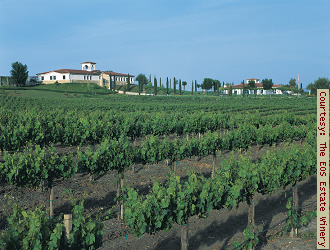
The EOS winery and Visitors Center overlooks Hwy 46.
According to Hopmayer, 30 percent of the fruit used by EOS (under Sapphire Wines) will continue to come from the Arciero family vineyards in Paso Robles. “The majority will come from area growers and we are even going to get some west side fruit” he said. Sapphire has also added the Lost Angel label to the portfolio. Jeff pointed out that in addition to renovating the visitors’ area, EOS is remodeling its winery facility.
We caught up with Nathan Carlson during this busy transitional period to talk about the move and the future.
redwinebuzz (rwb): Congratulations on the new position, Nathan. Jeff Hopmayer has a lot of good things to say about you and your winemaking resume.
Nathan Carlson (NC): When I worked at Laetitia and Sanford, it was really early in my career, and I was still just learning the ropes, so don't give me too much winemaking credit there!
redwinebuzz rwb: So 2008 will be your first vintage with EOS?
NC: That’s right. What’s exciting is coming on board with them at a time when they’re re-defining who they’re going to be. They’re taking big steps to be a leader in this region. EOS has always had good things about it and it’s always had challenges, too. They [Sapphire] really know the wine and spirits business. They know how to sell wine. They know what is important in the marketplace. They’ve kind of proven their acumen out there. For myself, I would never deign to be a marketing [expert] to understand everything about what consumers are attracted to and so forth. But I think that they have assembled a really good team. We’re going to get together and define our style very clearly so that we can act and move forward on making good decisions which are going to pay off for the company as we go forward.
rwb: Who will take over for you at Tolosa?
NC: Tolosa is in great shape and in great hands. Larry Brooks, who has been working with Tolosa for the past several years, is increasing his involvement and taking on some stronger management and winemaking roles for the company. Larry [formerly, wine maker at Acacia, Chalone Wine Group, independent consulting, etc] is one of the most accomplished Pinot Noir and Chardonnay winemakers in the state, and has been a consultant behind some of the most important brands in this genre. Tolosa's Director of Operations, Ian Herdman, is an incredibly solid palate, winemaker, and all around person in his own right. It has been a pleasure to work with these guys, and as the wines that we have made together roll out over the next two years, the quality and character of them will make Tolosa unstoppable. The amount of focus and definition that we have worked hard on over the last 4 seasons have paid off, and will carry the brand forward.
rwb: How long was Jeff pursuing you for the position?
NC: Well, they closed the deal on the winery about eight months ago, so I have known Jeff from about the day they [Sapphire] announced that they were going with full solar power for the winery. My partner of eight years, Kristin Carlton, works in compliance for the beverage industry [Compli Beverage Compliance]. Sapphire was an established client of her company, and when they bought the winery, they invited us all to dinner. So I met Jeff, Fred and some of the other management at Sapphire at that time and we just got to talking. I liked where he was going with taking this big step towards sustainability. I think that when somebody buys a property that is as big as EOS and then commits to doing the right thing, it’s influencing other large wineries to go in the same direction. That was important, symbolically, for me to see that he was really committed to doing the right thing.
I think it was shortly after that he came down to tour Tolosa and take a look around at how we ran things at Courtside [Cellars]. EOS and Tolosa are pretty similarly-sized
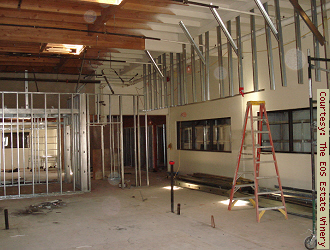
The public and working areas of EOS are being remodeled.
rwb: Can you explain the structure of Courtside Cellars and its relationship to Tolosa?
NC: Tolosa Winery operates within Courtside Cellars. [The winemaking operation can be seen through large glass windows separating it from the Tolosa tasting room.] Courtside Cellars encompasses that facility as well as another facility in San Miguel, which can process about 10 times as much fruit. It’s a medium-to-large sized custom wine making business and as a service business for other wineries, it’s the main business of the partners [principals of Courtside Cellars and Tolosa Winery]. Between 5% and 10% of Edna Ranch fruit [Tolosa's estate vineyards], in most years, goes into the Tolosa label.
rwb: Is there anything you'll miss about Edna Valley and Tolosa?
NC: I have primarily worked in this one valley since I was about 22 years old, with the exception of a year in Oregon. I will miss seeing daily a lot of the people in the Edna Valley, waving at friends when driving out for vineyard checks. I will miss the way the air smells like dry anise when the Chardonnay is nearly ripe, and the way that the fog rolls in over San Luis Obispo every afternoon in the summer like a blanket. I'll miss taking a couple hours in the middle of a 14-hour harvest day to hop on a bike into town for lunch and a stress-break. I'll miss my team at Tolosa. They are a solid, organized family, and they keep getting better yearly at everything they do. I don't plan to go very far away, and will be stopping down to say hello and to taste with them as much as I am able.
Maybe one of the main things that I am proud of, (in addition to the Tolosa wines), and which has really prepared me for this new role with Sapphire, is my work in custom winemaking at Courtside Cellars, concurrent with Tolosa. At Courtside, my clients were among the largest wine companies in the world, and I made wines and pieces of wines for products that experienced huge growth and critical success. Several of these wines have been on AC Nielson's top 10 growth brand lists over the past few years, and I've been involved in making wines for export to Japan, Switzerland, the UK, and elsewhere in the world. It exposed me to working with fruit from Sonoma, Napa Valley, and throughout the Central Coast. This kind of client involvement has exposed me to thinking really clearly about wine style and wine quality from the ground up, about defining and achieving stylistic goals, and about communicating these goals with other people.
Sustainable spirit of EOS.
The last time he spoke with redwinebuzz.com, Jeff Hopmayer mentioned some eco-friendly changes to the EOS estate. On Friday, he said that EOS expects to be “100 percent solar powered by mid summer”. These efforts have not gone unnoticed. Jerry Lohr has hired the same company to install solar panels at his winery. Additionally, the city of Paso Robles has expressed interest in employing eco-friendly technology for its needs. Asked about the water conservation efforts on Friday, Hopmayer elaborated on his plans: “The solar panels are our first priority. The water conservation methods employ space station technology to re-use water. This means we can eliminate retention ponds which lose a lot of water to evaporation. This won’t be addressed 'till after August first”.
With his involvement in environmental conservation efforts and sustainable practices, Nathan Carlson certainly seems like a good fit for Hompayer's vision for EOS.
rwb: So you’re obviously passionate about socially and environmentally conscious efforts. You’re not one to wear that as the fashionable token badge.
NC: No way. I feel like I live it. That’s what I’m about, really.
rwb: What convinces you that the people with whom you become affiliated truly reciprocate and believe and live the values you espouse? What tells you that Sapphire is committed to an effort of substance rather than an effort of words?
NC: Well, you could certainly throw a couple solar panels up and call yourself “solar” and say that you’re producing a percentage of the energy that you need. But they’re putting a in big field [of solar panels]. It’s going to provide all the electricity for the winery. They’re really doing it. They’re not just talking about it. And not because it’s [a good financial decision]. They are looking at how it’s going to pay off, but it’s not something that’s going to pay off overnight, for sure. It’s a big investment. It goes beyond just lip service. It’s really going to be significant.
rwb: Jeff had mentioned some time ago that one of his goals was to reduce water waste through recycling etc. Can you give some more insight into these efforts at EOS?
NC: I know that the management team has been measuring water usage to get a sense of which production steps are the heaviest users. That is the first step in getting a handle on waste, and it will help us to prioritize our conservation efforts. Already, work is underway to change the tank temperature control systems, which should save huge amounts of water and energy. We are also going to look hard at barrel cleaning systems, which currently use steam and hot water in large quantities - using both a lot of water and energy. I think that we want to figure out the consumption and report it as "how many gallons of water does it take to make a bottle of wine."
Hopefully, within a few years, we will be among the most efficient wineries in the state in this regard. Even so, none of the process water is absolutely wasted. Currently, every drop is collected and biologically treated, and used for landscape irrigation.
rwb: How do you feel about organic and biodynamic farming?
NC: I think they’re both very well intentioned. I’m actually a member of the Biodynamic Farming and Gardening Association and I’ve pretty much tried in the past to run my garden at home in accordance with the Stella Natura calendars and using preparations and I was even in a study group at Cal Poly, where we made our own preps.
I think that maybe what’s making biodynamics work (and certainly there are some of the top estates in the world that are making it work, so something has to be right about it) is that you have farmers paying closer attention to what they’re doing. And that may be

The EOS Petite Sirah vineyards soak up the solar heat they thrive on.
These things certainly have a lot to do with soil health. Cultivating certain microorganisms and putting them out in a field can really change the nutrient uptake and the health of a plant. There’s been some really good research going on with that – even from a scientific standpoint – and some of it just looks to me like biodynamic preps are kind of crude ways to culture those same kind of bacteria and other microorganisms. There are certain fungi that can cooperate with plants and help them uptake nutrients or release them from clay particles where they’re trapped. The vine can then uptake those.
"Wherever you find yourself, there you are".
There is an undeniable phenomenon of the winemaker cult in California. The people (individuals or small groups) responsible for giving wine its final form are celebrated in a way that, some may say, disregards the role of the vineyard manager and the vineyard itself. Every year, it seems, winemakers leave one estate to work for another. These people carry their sensibilities and stylistic inclinations with them as they move to a new position. But what works in one AVA (or one particular site), may not work in another. The winemaker must be both knowledgeable and adaptable.
rwb: Can you talk a bit about the ecological (geology, climate, etc) differences between Edna Valley and Paso Robles and what will change for you when you go from growing and making wine at Tolosa to doing that at EOS? Is there a paradigm shift you have to make? Is there a different approach or attitude?
NC: The climates are incredibly different in South County versus North County, as they are separated by the Santa Lucia range, giving the inland Paso Robles region much higher daytime temperatures during the growing season. This dictates different cultivar choices, different pest and disease pressures, different cultivation and trellising techniques, different canopy management, and basically a very different mindset in every aspect of managing vineyard production and fruit quality. I will be going from working exclusively from one estate vineyard to working with a multitude of growers spread throughout the appellation, each dealing with their own challenges and advantages, and each with their own philosophy of how to grow the highest quality grapes.
However, I have been working with Paso Robles fruit for clients and in cooperation with several growers over the past 3 years. There are a few differences, particularly in the acid profiles, the tannin character, and the nutrient status of the musts. These are not paradigm shifts by any stretch. They are pretty easily managed differences, but it is important to be aware of them, and to anticipate them. Wines from the Edna Valley have a built-in elegance and restraint. Even at their most over-the-top, they are like the cute, studious girl in class who blushes when she curses. Carrying that analogy forward, maybe the Paso wines are like a sexy cowgirl: hardworking, attractive, and a little bit rowdy?
If there is any paradigm shift, perhaps it is going to be in interacting with people - I don't have just one vineyard management team to work with; I will have a number of them. They will have varying levels of understanding of vine physiology and wine quality; everything from Davis/Fresno graduate viticulturalists to farmers who just grow some grapes right along with their other crops and livestock, to people for whom grape growing is a hobby that got out of control. All of these growers are capable of succeeding with me and the EOS team in growing wines of the highest quality, but my interaction with each of them will be totally different.
Oh, and I think I am going to have to buy some cowboy boots!
rwb: In the press release, you are quoted referring to Paso Robles as "idealized" wine country. What do you mean by that?
NC: Paso Robles really is a region of farmers – wine businesses are often run and owned by families, and wine is a major part of everyday life for people in the community. The community has largely embraced and supported the local wine industry, and as the industry has matured it is supporting luxury resorts and quality restaurants that go along with wine tourism, but still avoiding the ‘Disneyland’ feel of the Napa Valley. Wine businesses here are really still about agriculture, and are there to be diverse businesses: you will still see cattle grazing and other agricultural crops growing alongside vineyards. Paso Robles is really still legit, and real, and authentic in a way that few other American wine regions are.
rwb: Tell me what the essence and ideal of Paso Robles wines are to you. How can that be put in generalities? How can that be put in terms of specific varieties? What about wine structure and character?
NC: To me, the palate of Paso Robles means richness, fruit as a major component, and round ripe flavor. They are wines that are absolutely approachable for the average American palate, but the best examples still possess sufficient depth and complexity to hold the interest of veteran wine drinkers. They are wines that are absolutely American in style and absolutely Californian. And the winemakers have similarly followed a very Californian, very American path of innovation, experimentation, and collaboration, quickly raising the average quality and renown of the area. The nearest parallel that I can think of is probably the Priorat or Jumilla in Spain, where the wines achieve great ripeness, and innovative winemakers are breaking old rules and paradigms in favor of personal vision and expanding their concept of what their wines can or should be. I am excited to be a part of that collaborative spirit of pushing quality forward.
rwb: Which techniques (growing and production) do you consider to be well suited for Paso Robles - in particular, EOS - and which do you think are poorly suited, though possibly still practiced?
NC: Paso Robles has such enormous diurnal temperature swings that I believe night picking (whether by machine or by hand) is almost an essential technique in the pursuit of quality. Mechanical harvesting, when done properly, has a much better place in Paso than it did in the Edna Valley. Varieties like Cabernet Sauvignon and Petite Sirah have clusters that are lankier and more easily shaken off the vine; whereas Pinot Noir gets pretty hammered by the time you get it off the vine, being such a small, tight cluster. Regardless, hand harvest is still the preferred method for luxury wines.
Winning in the "Most Overrated Viticultural Practice," category, I have to say that Dry Farming is one practice that still goes on in some vineyards which I am really hesitant to embrace. In an area which gets this hot and this dry during the growing season, careful monitoring of the plant's water status is very important. The ability to manipulate water availability in a subtle way is a crucial tool in the winemaker's bag of tricks.
I have tasted way too many dry farmed wines that have been obviously stressed, with a bizarre, negative combination of dried out, prune-like and under-ripe, bitter flavors and harsh tannins. I'd like to avoid that in the wines that I make.
And it isn't good for the vines, shortening their productive life, weakening their defenses against disease and pests and increasing the unevenness throughout the vineyard. Proper timing of irrigation has the ability to trigger vine hormonal cues, manage berry size, and to hold fruit on the vine for optimal tannin and color maturity. Dry farming is a little like bicycling blindfolded: sometimes you are going to pull it off and amaze the onlookers. But eventually it’s going to end in disaster.
Canopy management is crucial in every viticultural area. While working at Courtside Cellars, all of the winemakers would get together in the winter after the harvest and taste through the grower's wines. We worked cooperatively with many Paso area growers to make and market wines on the bulk market and to our other clients. When one of the partners started showing us photos of the vineyards we were tasting from, it was so clear that how the vineyard looked correlated directly with the quality of the wine. Vineyards with properly positioned shoots, good air circulation and some sunlight exposure on the fruit always made the best wine. Those that were sprawled out, with no clear fruit zone and stagnant air around the clusters exhibited traits of over and under ripeness at the same time, poor color density, and evidence of disease, rot, and sunburn.
rwb: Recent articles and discussions have suggested that irrigation becomes a crutch that results in the roots being clustered tightly together, close to the surface. Doesn’t dry farming encourage the vine to extend its root system?
NC: First of all, I would say that irrigation agriculture is not a real super-sustainable thing in the first place. And when we talk about vineyards, yes, they don’t need a lot of water. They really don’t. In a lot of years, there’s no irrigation going on at all ‘till you’re coming up into harvest. I think a lot of what you hear are theories about what the depth of the roots is. I don’t think it’s borne out by reality.
You know, a vine will grow its roots down to find water and nutrients. If you were exclusively irrigating and if you’re over-irrigating then, yes, you could grow your roots in a little ball right around the emitter. But that’s not really what’s going on most of the time in irrigated grapevine farming.
So what I’m saying is that if you’re dry farming as a philosophy, you’re limiting your ability to respond to what the vine really needs and you’re allowing the philosophy to take over the reality of what’s going to get you the best quality grapes on a year-in and a year-out basis.
Defining Future Paths.
rwb: The press release also mentions some “exciting experimental varietal programs" at EOS. Can you elaborate on that?NC: EOS has been known for a few varieties, principally Petite Sirah and Cabernet Sauvignon. We will be moving toward working with some of the most exciting growers in the region, both with these varieties, and with some of the other varieties such as Grenache, Syrah, Mourvèdre and Malbec. Paso Robles is starting to excel with these. Stay tuned
rwb: What do you plan on changing at EOS - in the vineyard and the cellar?
NC: Before I change anything, my first task is to get a sense of where we are starting from. EOS has so many good systems and organizational memory in place already, and I don't want to lose any of those just because I am accustomed to doing things in a different way.
Over the next month, I will be working hard with the production and management teams to really define where we want to go with the wines, so we can start with a clear stylistic and production goal in mind for each wine, and let that shape all the decisions going forward.
My winemakers and I will be tasting a lot of wines together, from EOS as well as competitors', neighbors', and wines from elsewhere in the world. This is crucial in today's market - we need to know the context that our wines will be viewed within, and today that includes wines from everywhere in the world.
I am going to be spending a lot of time with our growers, as I mentioned earlier. I recognize that our success is going to depend on their success, and I will give them the feedback and support that they need to be among the best in the region.
Jeff and the Sapphire team have been pretty clear that they are behind me in making changes in the cellar and in equipment if the changes are justified by increased efficiency and wine quality. They are currently completely re-vamping the production and laboratory areas - the new lab will be the envy of the region when it is complete. It will be almost ridiculously beautiful! The barrel and tank cellars will follow soon behind.
I don't believe that the newest, 'best' equipment automatically makes the wine better. I believe that better wine comes from a clear purpose, and a clear understanding of what each viticultural and enological step should accomplish. That said, once theory and technique are understood, the proper selection of tools makes the process of carrying out and achieving these goals easier and more efficient. If you make it easy to do things the right way, it becomes more likely that they will be done in that way!
Nathan Carlson is a very engaging person – both on an interpersonal and intellectual level. He sees wine and winemaking as a multifaceted microcosm. Not the least of his interests is sustainable farming. He lives his passions on a daily basis. In talking about the fiscal and philosophical motivations for going green, Hopmayer points out: “The fiscal issues are only initial. In the long run, you have to do what’s right. I feel I’m obligated to leave this place better than I found it – for my kids”. This philosophy certainly resonates with Carlson’s beliefs and principles. EOS is gearing up to become a formidable presence and a trendsetter in Paso Robles and California wines.
Stay tuned.

READER FEEDBACK: To post your comments on this story,