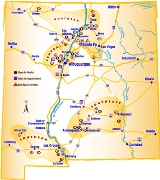
How New Mexico connects wines, tourism and its unique cuisine
by
Eleanor & Ray Heald
March 4, 2008 New Mexico has tremendous historical relevance to North American and US wine production. Predating most known wine states of today by a century the industry became shadowed by evolved appellations such as California, but vines never left this ground. Today a revitalization continues across the state. Most vineyards are in the far south but brave soles have pushed up the Rio Grande to places above Sante Fe and canyons just short of Taos. Winemaking talent certainly followed. [>] see full story
|

Current Feature
 Bi-State Upper Hiwassee Highlands an AVA
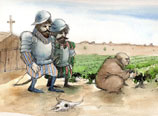
 In the southern Blue Ridge Mountains of North Carolina and Georgia vineyards are small and few, yet the establishment of the Upper Hiwassee Highlands could bring much more. [>] continue
Appellation Features
 Bringing the people to the wine:
 How New Mexico connects wines, tourism and its unique cuisine By Eleanor & Ray Heald
March 4, 2008
[>] see all New Mexico features (1)
 Remote Manton Valley New California AVA
 WAWGG Banquet Explores Washington State Terrior
 Taking Focus on Appellation
 Whitehall Lane Winery, A 20 Year Story of Vineyards
 Embracing Virginia’s Terroir
  Appellation America to Drop Paywall - Provide Open Access
 Shake Ridge Ranch - Gem of the Sierra